9.9 Print matrix in zig-zag fashion, in C.
9. Basic Matrix Algorithm Problems in C
Full Course on Data Structures and Algorithms in C
By: Chrysanthus Date Published: 16 May 2026
The reader is advised to read all the lessons (tutorials) in this full course, in the order presented.
Problem
Given a matrix of 2D array of n rows and m columns, print this matrix in ZIG-ZAG fashion as shown in the following figure:
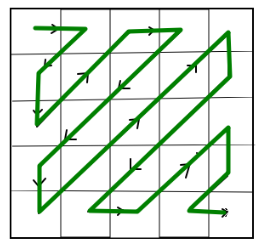
Example 1:
Input: mat[][] = {{1, 2, 3}
                  {4, 5, 6}
                  {7, 8, 9}}

Output : 1, 2, 4, 7, 5, 3, 6, 8, 9

Example 2:
Input: mat[][] = {{1,  2,  3,  4,  5},
                  {6,  7,  8,  9,  10},
                  {11, 12, 13, 14, 15},
                  {16, 17, 18, 19, 20}};
Output : 1, 2, 6, 11, 7, 3, 4, 8, 12, 16, 17, 13, 9, 5, 10, 14, 18, 19, 15, 20
Solution in O(n x m) Time
The algorithm is as follows:
- Visit the top-left element first. Visit the next element on the right.
- Continue visiting the current minor diagonal elements in the left-downwards direction until meeting the left edge or bottom edge of the matrix.
- If the left edge of the matrix is met and not the bottom edge, visit the next element below.
- Continue visiting the current minor diagonal elements in the right-upwards direction until meeting the top edge or right edge of the matrix.
- If the bottom edge of the matrix was met, and not the left edge, then visit the next element on the right at the bottom edge.
- Continue visiting the current minor diagonal elements in the right-upwards direction until meeting the top edge or right edge of the matrix.
- If the top edge of the matrix is met and not the right edge, visit the next element on the right.
- Continue visiting the current minor diagonal elements in the left-downwards direction until meeting the left edge or bottom edge of the matrix.
- If the right edge of the matrix was met, and not the top edge, then visit the next element below.
- Continue visiting the current minor diagonal elements in the left-downwards direction until meeting the left edge or bottom edge of the matrix.
- Continue repeating the above steps accordingly, until the element at the bottom-right corner of the matrix is met, which will always be met, either from the left or from above.
- Do not forget to consider the cases, where the visit is at the four corners.
There are eight cases to consider: when the visit is at the four corners and when the visit is at the four edges. The case of what happens after the visit of the bottom-right element, does not have to be addressed. This gives rise to seven code segments in a major while-loop.
Indexes
The top most row of the matrix is identified by i=0.
The leftmost column of the matrix is identified by j=0.
The bottommost row of the matrix is identified by i=n-1.
The rightmost column of the matrix is identified by j=m-1.
The program
The program is (read through the code and comments):
#include <stdio.h>

void zigZagMatrix(int mat[][5], int n, int m) {
    int i=0, j=0;

    while (i < n && j < m) {
        if (i == 0 && j == 0) {    //top-left corner
            printf("%i, ", mat[i][j]);
            j++;    //go right once
            printf("%i, ", mat[i][j]);
            while (j > 0 && i < n-1) {    //end at left or bottom edge
                i++; j--;    //go down and left
                printf("%i, ", mat[i][j]);
            }
        }

        if (j == 0 && i > 0 && i < n-1) {    //left edge and not top or bottom ends
            i++;    //go down once
            printf("%i, ", mat[i][j]);
            while (i > 0 && j < m - 1) {    //end at top or right edge
                i--; j++;   //go right and up
                printf("%i, ", mat[i][j]);
            }
        }

        if (i == 0 && j > 0 && j < m-1) {    //top edge and not left or right ends
            j++;    //go right once
            printf("%i, ", mat[i][j]);
            while (j > 0 && i < n-1) {    //end at left or bottom edge
                i++; j--;    //go down and left
                printf("%i, ", mat[i][j]);
            }
        }

        if (i == n-1 && j == 0) {    //left-bottom corner
            j++;    //go right once
            printf("%i, ", mat[i][j]);
            while (i > 0 && j < m - 1) {    //end at top or right edge
                i--; j++;   //go right and up
                printf("%i, ", mat[i][j]);
            }
        }

        if (i == 0 && j == m-1) {    //top-right corner
            i++;    //go down once
            printf("%i, ", mat[i][j]);
            while (j > 0 && i < n-1) {    //end at left or bottom edge
                i++; j--;   //go down and left
                printf("%i, ", mat[i][j]);
            }
        }

        if (i > 0 && i < n-1 && j == m-1) {    //right edge and not top or bottom ends
            i++;    //go down once
            printf("%i, ", mat[i][j]);
            while (j > 0 && i < n-1) {    //end at left or bottom edge
                i++; j--;    //go down and left
                printf("%i, ", mat[i][j]);
            }
            //bottom-right end of matrix
            if (i == n-1 && j == m-1) {
                i++; j++;    //increase i and j to stop the big while-loop
            }
        }

        if (j > 0 && j < m-1 && i == n-1) {    //bottom edge and not left or right ends
            j++;    //go right once
            printf("%i, ", mat[i][j]);
            while (i > 0 && j < m-1) {    //end at top or right edge
                i--; j++;    //go right and up
                printf("%i, ", mat[i][j]);
            }
            //bottom-right end of matrix
            if (i == n-1 && j == m-1) {
                i++; j++;    //increase i and j to stop the big while-loop
            }
        }
    }
    printf("\n");
}

int main(int argc, char **argv)
{
/*
    int n=3, m=3;
    int mat[3][3] = {{1,  2,  3},
                     {4,  5,  6},
                     {7,  8,  9}};

    zigZagMatrix(mat, n, m);
*/
/*
    int n2=4, m2=5;
    int mat2[4][5] = {{1,  2,  3,  4,  5},
                      {6,  7,  8,  9,  10},
                      {11, 12, 13, 14, 15},
                      {16, 17, 18, 19, 20}};

    zigZagMatrix(mat2, n2, m2);
*/
    return 0;
}
Remove the first pair of the block comment markers (/* */). Make the first argument of the called function, "int mat[][3]". Run the program and the output should be:
1, 2, 4, 7, 5, 3, 6, 8, 9,
Put back the first pair of the block comment markers (/* */). Remove the second pair of the block comment markers (/* */). Make the first argument of the called function, "int mat[][5]". Run the program and the output should be:
1, 2, 6, 11, 7, 3, 4, 8, 12, 16, 17, 13, 9, 5, 10, 14, 18, 19, 15, 20,
The time complexity is actually O(2 n x m), with the first O(n x m) for populating the input matrix with all the elements, and the second O(n x m) for iterating over all the elements in the matrix in the called function. Since the coefficient (multiplicand of 2) is usually omitted, the time complexity is quoted as O(n x m).
The space complexity is O(n x m), for the input matrix, which is the same as the matrix in the called function (same reference).
Thanks for reading.
Related Links
More Related LinksCousins
BACK NEXTComments
Note: You can use the Search Box above to find articles and discussions of interest.