9.10 Print a matrix in spiral form, in PHP.
9. Basic Matrix Algorithm Problems in PHP
Full Course on Data Structures and Algorithms in PHP
By: Chrysanthus Date Published: 16 May 2026
The reader is advised to read all the lessons (tutorials) in this full course, in the order presented.
Problem
Given a matrix mat[][] of size n x m, the task is to print all elements of the matrix in spiral form, as shown in the following figure:
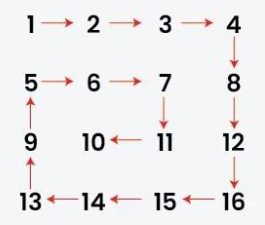
Employ boundary traversal technique.
Example:
Input: mat[][] = {{1,  2,  3,  4,  5},
                  {14, 15, 16, 17, 6},
                  {13, 20, 19, 18, 7},
                  {12, 11, 10, 9,  8}};
The input numbers have been given in spiral form, and should just be read.
Output : 1, 2, 3, 4, 5, 6, 7, 8, 9, 10, 11, 12, 13, 14, 15, 16, 17, 18, 19, 20
Solution
The algorithm is as follows:
- Traverse the top row from j=0 to j=m-2.
- Traverse the rightmost column from i=0 to i=n-2.
- Traverse the bottom row from j=m-1 to j=1.
- Traverse the leftmost column from i=n-1 to i=1.
- Traverse the second row from j=2 to j=m-3.
- Traverse the last-but-one rightmost column from i=1 to i=n-3.
- Traverse the last-but-one bottom row from j=m-2 to j=2.
- Traverse the second leftmost column from i=n-2 to i=2.
- Traverse the third row from j=3 to j=m-4.
- Continue the traversing in the spiral form. - - -
- - - - - -
The program
The program is (read through the code and comments):
<?php

    require_once 'vendor/autoload.php';

    use Rindow\Math\Matrix\MatrixOperator;

    // Initialize the Matrix Operator
    $mo = new MatrixOperator();

    function spirallyTraverse($mat) {
        //Determine dimensions automatically via the shape() method
        $shape = $mat->shape();
        $n = $shape[0];
        $m = $shape[1];

        //Let a be the difference between the row being traversed, and i=0.
        //Let b be the difference between the column being traversed, and j=0.
        $a = 0;
        $b = 0;
        //Let c be the difference between the bottom of the matrix and the traversing column end element index.
        //Let d be the difference between the right end of the matrix and the traversing row end element index.
        $c = 1;
        $d = 1;

        $totalNumOfElements = $n * $m;
        $counter = 0;

        $i=0; $j=0;
        while ($counter < $totalNumOfElements) {
            // Traverse top current row from left to right
            for ($j=$j+$b; $j < $m-$d; $j++) {
                echo($mat[$i+$b][$j] . ", ");
                $counter++;
            }

            // Traverse last current column from top to bottom
            for ($i=$i+$a; $i < $n-$c; $i++) {
                echo($mat[$i][$j] . ", ");
                $counter++;
            }

            // Traverse current bottom row from right to left
            if ($n > 1) { // Check to avoid duplicating row in single-row matrix
                for ($j = $m - $d; $j > $b; $j--) {
                    echo($mat[$n-$c][$j] . ", ");
                    $counter++;
                }
            }

            // Traverse current first column from bottom to top
            if ($m > 1) { // Check to avoid duplicating column in single-column matrix
                for ($i = $n - $c; $i > $a; $i--) {
                    echo($mat[$i][$j] . ", ");
                    $counter++;
                }
            }

            $a++; $b++; $c++; $d++;
        }

        echo PHP_EOL;
    }

  // main area
    $mat = $mo->array([[1,  2,  3,  4,  5],
                       [14, 15, 16, 17, 6],
                       [13, 20, 19, 18, 7],
                       [12, 11, 10, 9,  8]]);

    spirallyTraverse($mat);

?>
The output is:
1, 2, 3, 4, 5, 6, 7, 8, 9, 10, 11, 12, 13, 14, 15, 16, 17, 18, 19, 20,
The time complexity is actually O(2 n x m), with the first O(n x m) for populating the input matrix with all the elements, and the second O(n x m) for iterating over all the elements in the matrix in the called function. Since the coefficient (multiplicand of 2) is usually omitted, the time complexity is quoted as O(n x m).
The space complexity is O(n x m), for the input matrix, which is the same as the matrix in the called function (same reference).
Thanks for reading.
Related Links
More Related LinksCousins
BACK NEXTComments
Note: You can use the Search Box above to find articles and discussions of interest.